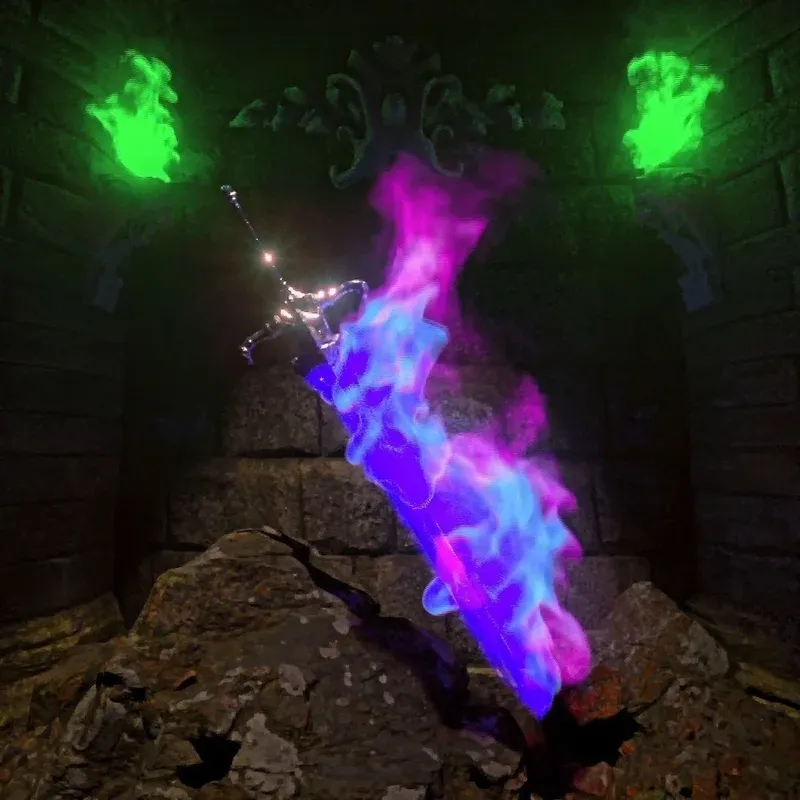
A broadsword hangs point-down in a stone alcove, its blade swallowed by flame. The fire runs cold — deep violet at the core, electric blue on the leading edges, magenta where the plume tears loose past the crossguard. Behind it, two green sconces flank a carved gothic relief — the only other light in the frame. Everything else is dark masonry: mortar lines, chipped block faces, a broken floor catching just enough bounce to read as rock rather than silhouette.
The composition leans. The sword runs diagonally from lower-right to upper-left and the flame follows, so the eye travels the blade and keeps going into the smoke.
“Demo” is honest. This was an exploration into pyrodynamics and, just as much, into the multi-app workflow it demands: simulate the volume in EmberGen or Houdini, hold the scene in Cinema4D or Blender, resolve the light in Octane, finish in Photoshop where a frame needs it. A blade-mounted plume is the harder version of that problem, narrow and fast where smoke would rather be broad and slow. What I wanted out of the frame was fire’s other register, the chaotic torsion and the intensity of it, rather than the calm.
Three tools, three jobs
- EmberGen produces the flame. A blade-mounted plume is a narrow, fast-moving source, which is a harder shape to keep coherent than a broad column of smoke.
- Cinema4D holds the solid world: sword, alcove, camera, timing. An imported volume sequence sits in that scene like any other object.
- Octane path-traces it, and that is where fire stops being a picture of fire and becomes a light. The violet wash on the mortar lines, the cool rim along the floor slabs, the falloff behind the plume — none of it is painted in. It falls out of the render because the volume emits.
A flame comped over a plate stays on top of the plate. A flame that lights the room is in the room.
What the fire is doing to the metal
The interesting read isn’t the plume, it’s the blade under it, defined mostly by what the fire isn’t covering — a hard silver edge where the flame thins near the tip, the crossguard lit violet from above and unlit below, the pommel spikes surviving as sparks and a suggestion of shape. Volumetric fire and thin hard-surface geometry fight each other in a render: the volume eats detail, the metal throws it back. The frame holds because density over the blade stays low enough to keep the silhouette legible while still selling a sword on fire rather than near one.
The green sconces are the counterweight — far enough from violet on the wheel that neither gives up saturation, and they establish the room as lit before the fire says anything.