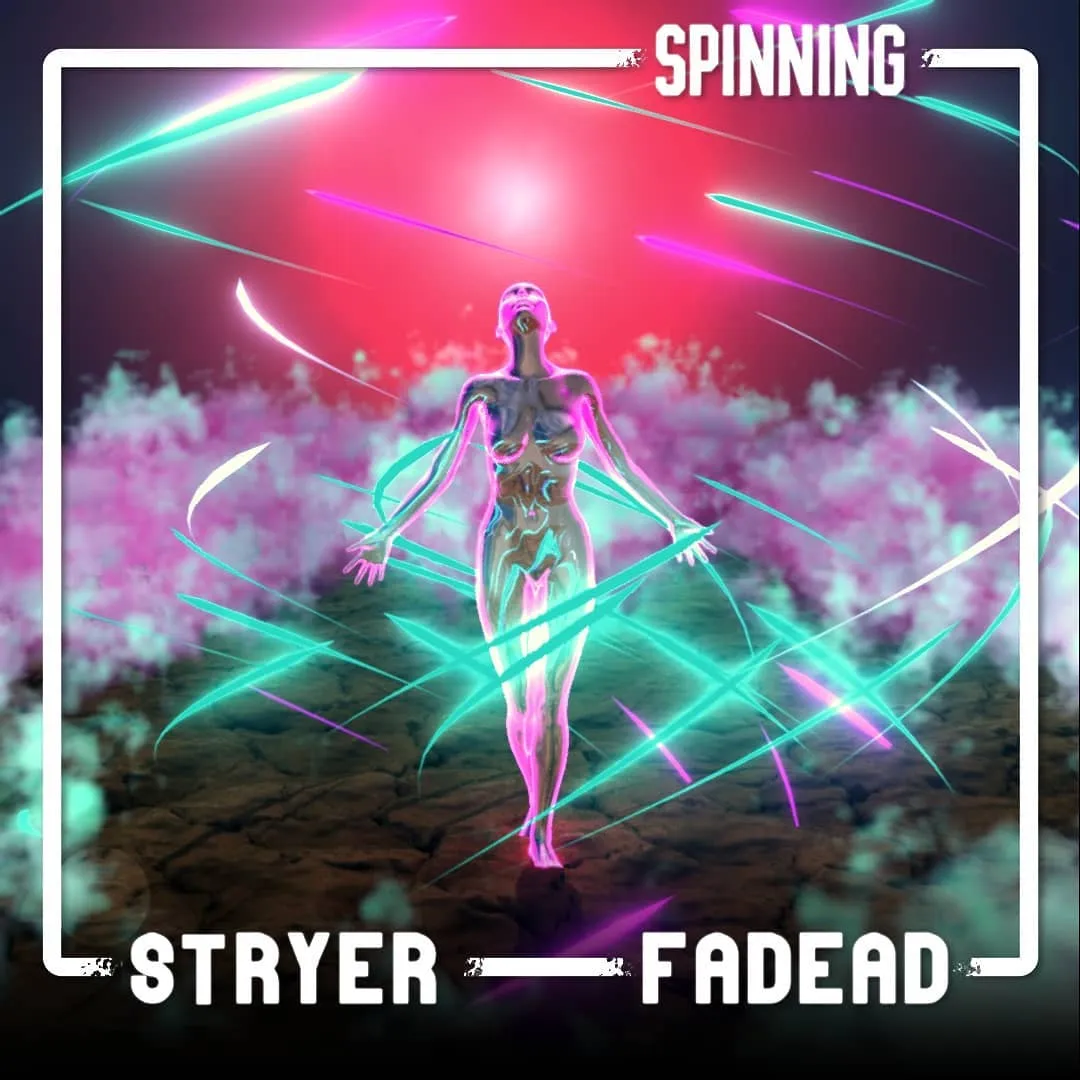
A chrome figure stands barefoot on cracked earth, arms open, head tilted back toward a magenta sun that blows out to near-white at its core. Ribbons of cyan cut across the frame in long arcs — some wrapping the body like a lasso caught mid-rotation, others streaking off past the edges as pure highlight. Banks of pink and teal smoke sit low on the horizon, lit from behind. A thin white border frames it all, with the title in the corner and the two artist names anchoring the bottom edge.
Identity work for a nascent EDM party crew, built fast. A chrome body, a blown-out sun, one saturated colour carrying the structure, and two artist names seated along the bottom edge. Holding a vocabulary still across several releases is what makes a crew read as a crew instead of a run of unrelated tracks, so the repetition is the deliverable rather than a shortcut. Speed mattered more than polish. A young party crew needs to look like something before it is something.
One lighting budget, four things fighting over it
In Notch every element in this frame is drawing from the same pool of light. The sun’s bloom, the volumetric smoke, the reflections on the body, and the emissive streaks aren’t separate passes to be stacked later — they resolve together on the GPU, which means they compete. Push the sun’s intensity and the bloom starts eating the figure’s shoulders. Add smoke density and it stops reading as distance and starts reading as fog on the lens. Brighten the streaks and the mirrored surface picks them up everywhere at once.
In the finished frame the core of the sun is fully blown out, but the blowout stops short of the raised arms, so the silhouette keeps a top edge.
Why the cyan does the work
The figure itself is a fairly quiet element: a mirrored surface with no texture of its own, so almost everything on it is borrowed. The pink rim down its left side and the teal along its arms are the environment reflecting back. That’s why the streaks matter structurally rather than decoratively — they’re the light source that gives the body its edges.
They also carry the title. A long line with a slight curve reads as the path something moving left behind it, and stacking enough of those around a stationary pose puts rotation into a frame that contains none. Nothing in the image is actually turning — the figure’s feet are planted and its weight is even. The spin is entirely inferred from the arcs, which is a trick a still image gets to play that a moving one can’t — in motion, the eye checks the arcs against the body and catches it standing still.