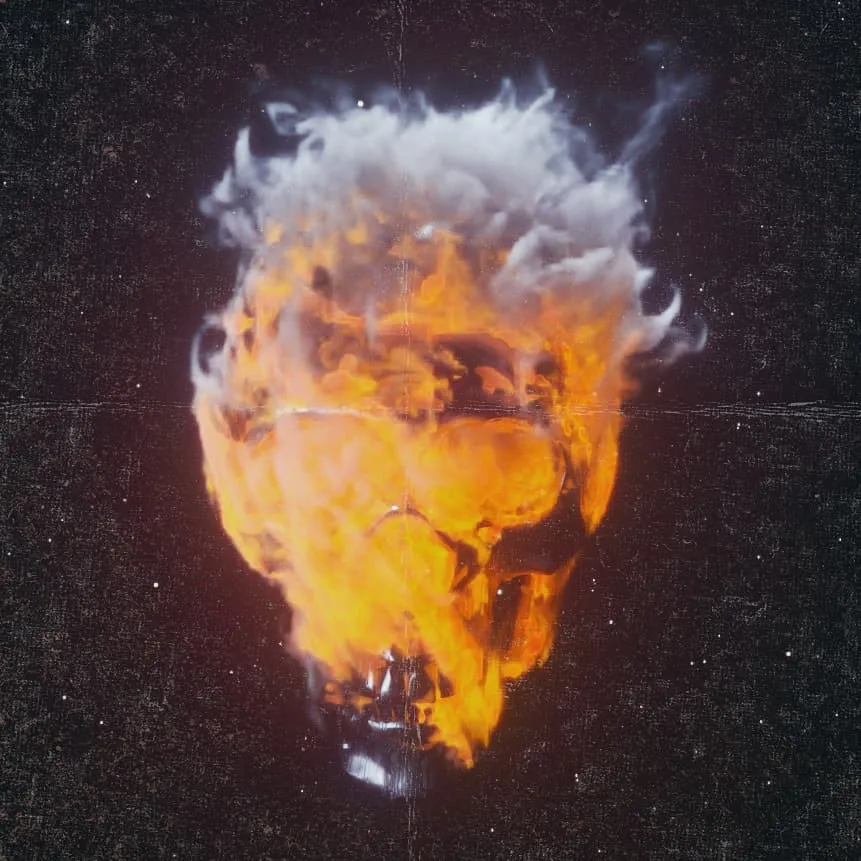
The jaw is the hottest thing in the frame, blown clean out to white. From there the fire climbs — hot orange and yellow eating the bottom two thirds of a skull that faces you straight on, sitting dead center in a square crop. The eye sockets and cheekbones survive only as darker gaps inside the flame. Above the crown the plume cools into smoke: grey-white, curling outward in soft lobes, the calmest thing in the picture. Over all of it sits a layer of dust and grain, faint horizontal scratches, a hairline seam running through the middle, and a scatter of small bright specks that reads as film dirt. The whole image looks scanned off a print more than rendered.
The same client job, down its other pipeline. The DJ’s Ghost Rider brief is at its most literal here, a burning skull head-on, and because this one did not have to run live it could be simulated, rendered offline and then finished as a flat image rather than performed. That let it be fire at full intensity instead of the ethereal register: a jaw blown out past white, the lower two thirds of the frame consumed, and the smoke above the crown left as the only calm in the picture.
How this kind of frame gets built
The pipeline behind an image like this splits cleanly along its two halves — the solid thing and the thing that has no surface.
- Cinema4D holds the skull, the camera, and the framing. Dead-center symmetry like this is a scene-layout decision, not a simulation one.
- EmberGen does the fire and smoke. What matters for a frame like this one is how quickly the flame hands off to smoke, because that handoff is the whole silhouette of the plume.
- Octane renders the result, and it’s what lets fire like this sit believably in a black void. Emissive volumes light themselves and nothing else, so the falloff into the background stays honest — no rim light arriving from a source that doesn’t exist.
- Photoshop is where the grain, the dust, the scratches, and the paper seam land, print texture sitting on top of the rendered image rather than inside it.
Why the darkness is doing the work
Volumetric fire only reads as bright if there’s nothing competing with it. On a black field, the smoke plume becomes the composition’s second subject — it’s the part that carries value range and edge detail while the flame itself clips to white. Fire wants to blow out. Smoke is what keeps a frame like this from being a blob.